
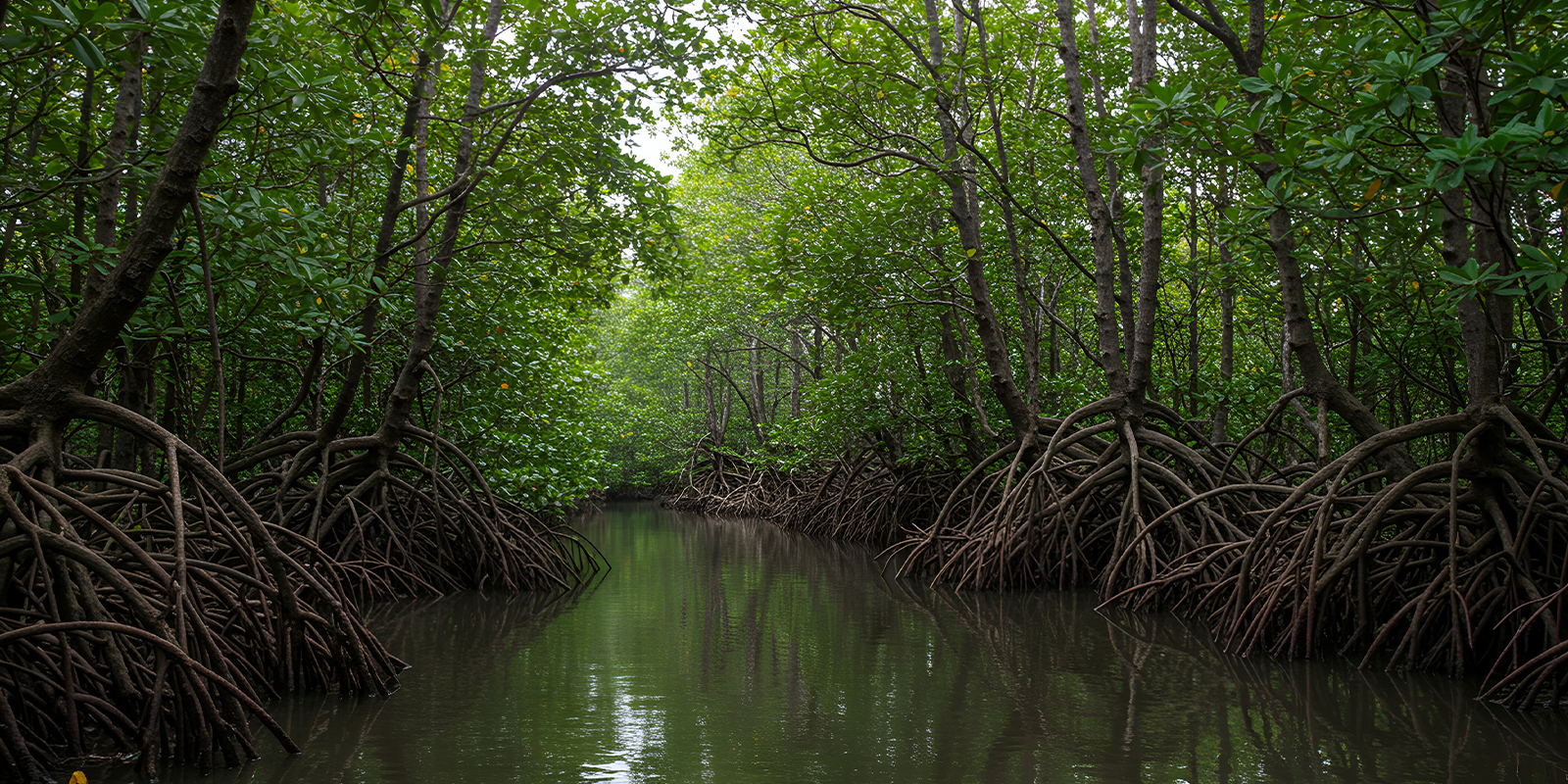
Along the tropical and subtropical coastlines of more than 120 countries, a unique group of salt-tolerant trees and shrubs thrives in the intertidal zone where land meets sea. These are the mangroves. Though they cover only a fraction of the planet’s forests—roughly 147,000 square kilometres, less than 1 percent of global tropical forest cover—they deliver ecosystem services so concentrated and irreplaceable that many scientists and conservationists regard them as among the most valuable plants on Earth.
Their importance is not sentimental. It is biophysical, economic, and existential. Mangroves stabilise coastlines, store vast quantities of carbon, sustain fisheries that feed millions, filter water, and support extraordinary biodiversity. Losing them exacts costs that no engineered alternative can fully replace. Protecting them at all costs is therefore not hyperbole—it is pragmatic necessity for coastal communities, climate stability, and the health of marine ecosystems worldwide.
Living at the Edge: What Makes Mangroves Unique
Mangroves possess specialised adaptations that allow them to survive in harsh, saline, oxygen-poor conditions. Many species develop complex aerial root systems—prop roots, pneumatophores, and knee roots—that provide stability in soft sediments and enable gas exchange. These roots also trap sediment, build land, and create a three-dimensional underwater forest that serves as critical habitat.
Unlike most terrestrial trees, mangroves occupy the dynamic interface between freshwater, saltwater, and land. This position makes them biological bridges. They link terrestrial and marine food webs, buffer the impacts of both, and support adjacent ecosystems such as coral reefs and seagrass meadows by reducing sediment loads and improving water quality.
Biodiversity Powerhouses and Fishery Nurseries
Mangrove forests harbour remarkable biological diversity. They provide habitat for more than 1,500 species and serve as essential nursery grounds for many commercially important fish, crustaceans, and molluscs. Juvenile fish find shelter among the tangled roots from predators, while the nutrient-rich environment supports rapid growth before many species move offshore.
Hundreds of threatened species depend on these habitats, including certain tigers, sea eagles, seahorses, and sawfish. Over a third of small-scale fishers in mangrove-rich countries rely on these ecosystems for their livelihoods. In some regions of Southeast Asia, a substantial proportion of commercial fish catches is linked, directly or indirectly, to mangrove productivity. Destroying the nursery collapses the downstream fishery.
Nature’s Coastal Defence System
The dense root networks of mangroves dissipate wave energy, reduce storm surge heights, and trap sediments that would otherwise erode shorelines. Studies show significant reductions in wave height over relatively short distances of forest, with effectiveness increasing with forest width, density, and structural complexity.
Globally, mangroves are estimated to reduce flood risk for more than 15 million people and prevent tens of billions of dollars in property damage every year. In many developing coastal regions, they function as the primary line of defence against cyclones, storm surges, and even tsunamis. Unlike concrete sea walls, mangroves are self-repairing, adaptive to moderate sea-level rise (when sediment supply is adequate), and provide co-benefits rather than single-purpose protection.
Blue Carbon Champions
Mangroves rank among the most carbon-rich ecosystems on the planet. On average they store around 1,000 tonnes of carbon per hectare when both biomass and underlying soils are considered—far higher per unit area than most terrestrial forests. Much of this carbon is locked in waterlogged soils for centuries because the anaerobic conditions slow decomposition.
These “blue carbon” forests sequester carbon at rates several times higher than many upland forests. When mangroves are cleared or converted, the stored carbon is released, contributing substantially to greenhouse gas emissions. The economic damage from such emissions has been estimated in the billions of dollars annually. Conserving and restoring mangroves therefore offers one of the highest-impact nature-based solutions for climate mitigation available.
Water Quality, Livelihoods, and Broader Services
Mangrove roots and associated microbial communities filter nutrients, heavy metals, and other pollutants, improving coastal water quality. They support timber and non-timber products, traditional medicines, and increasingly, sustainable ecotourism. UNEP has estimated the value of mangrove ecosystem services at US$33,000–57,000 per hectare per year in many developing countries—figures that frequently exceed the returns from converting the same land to aquaculture or agriculture when all costs and benefits are properly accounted for.
Why “At All Costs”?
The case for absolute prioritisation rests on three realities.
First, the services are concentrated and difficult to replace. A narrow belt of healthy mangroves can protect thousands of people and generate fisheries value that engineered solutions cannot match at comparable cost. Once destroyed, full recovery of carbon stocks, structural complexity, and biodiversity can take decades or longer—and many restoration attempts fail when hydrology, site selection, or community involvement are inadequate.
Second, the threats remain severe. Conversion to shrimp ponds, rice fields, oil palm, and urban development has driven substantial historical losses. Although the global rate of net loss has slowed and some natural expansion and recovery has occurred in recent years, more than half of the world’s mangrove ecosystems are assessed as at risk of collapse. Climate change adds pressure through sea-level rise, altered sediment dynamics, and increased storm intensity.
Third, the economic and social arithmetic favours protection. Short-term private gains from conversion often ignore the public costs of increased flood risk, lost fisheries, carbon emissions, and diminished resilience. When these externalities are included, intact mangroves frequently deliver higher long-term net benefits.
The Path Forward
Protection must come first. Halting further conversion of remaining high-quality stands is more effective and less expensive than later restoration. Where restoration is needed, success depends on restoring natural hydrology and allowing natural recruitment rather than mass planting in unsuitable locations. Community stewardship, secure tenure, and integration of mangroves into coastal spatial planning and climate strategies are essential.
Policy tools already exist: inclusion in national climate commitments, blue carbon finance, stronger protected-area networks, and sustainable aquaculture practices that leave buffer zones of mangroves intact. International initiatives and high-resolution monitoring (such as the Global Mangrove Watch) provide the data needed for accountability.
Mangroves are not merely important plants. They are living infrastructure that underpins coastal safety, food security, climate regulation, and marine biodiversity. In an era of accelerating climate change and biodiversity loss, few natural systems offer such a dense concentration of irreplaceable benefits. Protecting them at all costs is not radical. It is the rational response of a species that depends on the integrity of its coastal margins. For the future of Aqua-Ecology and of the communities that live along the world’s tropical shores, the choice is clear: safeguard these forests, or pay a far higher price later.
Leave a Reply