
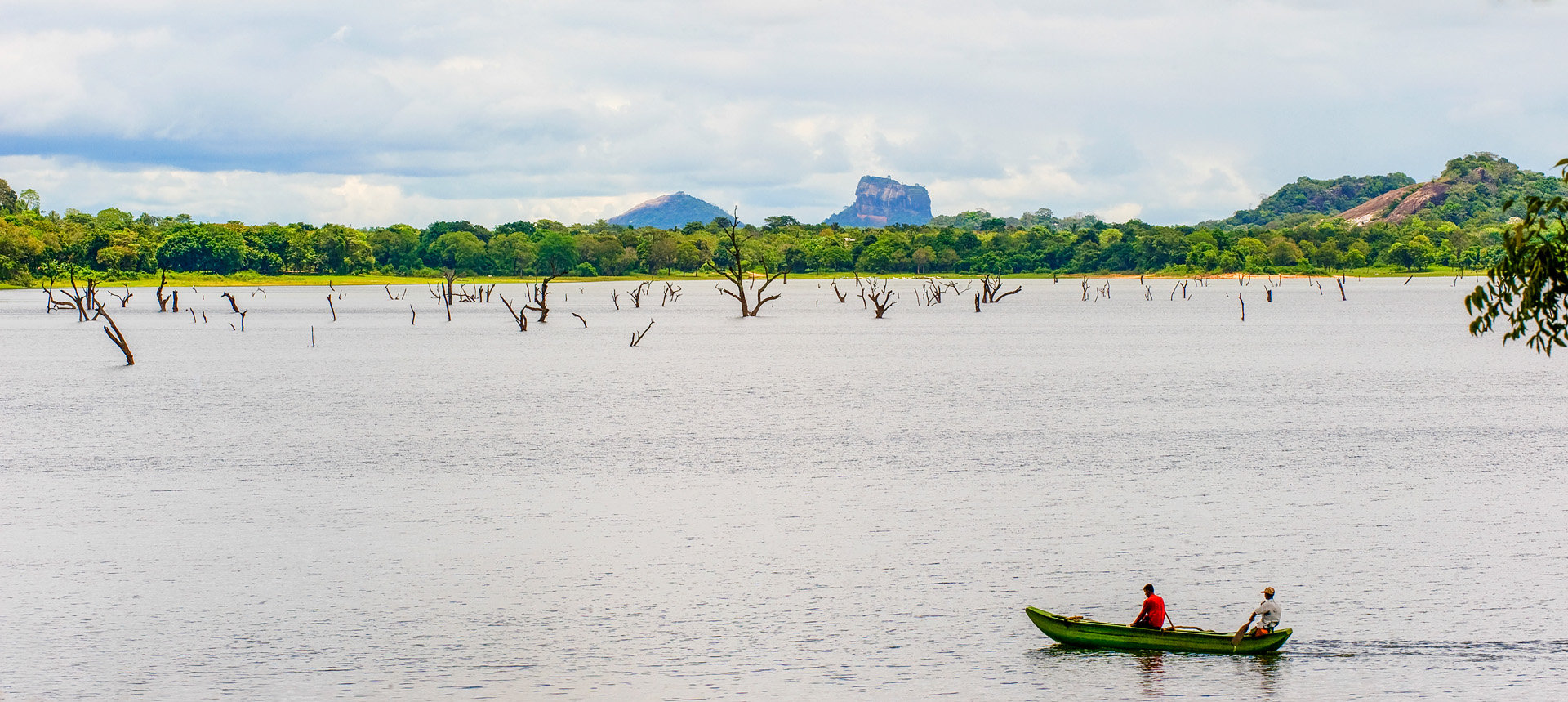
Every civilization on Earth began near a natural water source such as a river or a lake. As time passed, it was no longer possible for people to build all their settlements beside those natural waters. Yet water remained the main force behind any civilization, so people began to create their own supplies, wells, ponds, canals, and reservoirs. Because those works were artificial and man made, they often struggled to last against natural forces. Ancient Sri Lanka showed another way. In the dry zone, builders did not drop a single wall across a valley and call the problem solved. Instead they shaped a living chain of small lakes, forests, reed beds, and rice fields that harvest rain the way a watershed already wants to move. They showed us how to build artificial water bodies that stay closer to nature and work in an environmentally sound manner, so they remain truly sustainable and last for millennia. That system is the traditional Sri Lankan tank system called the “wewa”.
Across the dry zone of Sri Lanka, water does not sit in one giant basin waiting to be piped away. It moves through a living chain of small lakes, forests, reed beds, soil ridges, sluices, and rice fields. That chain is the traditional “wewa” more precisely the Village Tank Cascade System (ellangawa), a network of interconnected tanks that has watered people, paddy, and wildlife for more than two thousand years.
In 2017 the world’s Food and Agriculture Organization ( FAO ) recognized the cascaded tank village system as a globally important agricultural heritage system. That recognition was not nostalgia. It was an admission that an ancient landscape design still solves problems that many modern reservoirs create siltation, salt, evaporation, flood pulse, drought collapse, and the erasure of habitat. This article walks you through the system from ridge to hamlet, names each important component, and shows why those parts work together as ecology rather than as isolated engineering.
A landscape designed for a hard climate
Sri Lanka’s dry zone receives rain in two humid pulses and then faces long, hot drought. Much of the basement rock is crystalline and poorly permeable, so rain becomes surface runoff and would otherwise rush toward the sea. Ancient builders did not fight that geology. They used it. They placed earthen bunds across shallow valleys so that runoff collected step by step, from forested headwaters down to village tanks and paddy.
A single cascade may contain from a handful to about thirty tanks. Size generally increases downstream. Neighbouring valleys can be linked by channels. Excess water from one wewa becomes the inflow of the next. Water is harvested, stored, reused, and finally returned to the landscape instead of being treated as a one-way commodity.
Estimates of the historical stock range around 18,000 to 30,000 tanks across roughly 40,000 square kilometres of dry zone — an extraordinary density of small water bodies rather than a few mega-dams. Many still function. Together they occupy a few percent of the island’s surface and shape its climate, groundwater, and wildlife.
The governing idea, often linked to King Parākramabāhu I, was simple and radical: do not let a drop reach the ocean unused. The method was not a single monument. It was a watershed treated as one organism.
Not one tank but many kinds of “wewa”
Calling every water body a “reservoir” hides the system’s intelligence. Traditional classification assigned different tanks different jobs:
- Kulu wewa — small forest or headwater tanks. Their main purpose is not irrigation. They trap silt, feed groundwater, and give wildlife a place to drink so animals need not enter the village.
- Kayan wewa — tanks placed to intercept sediment and help manage salinity before water reaches the main village tank.
- Olagam wewa — side-valley or supplementary tanks that spill into the main chain and can support fields when the principal tank is short.
- Pin wewa — temple tanks, tying water to religious and communal care.
- Wathura bona wewa and nana wewa — tanks or designated reaches used for drinking and bathing, kept cleaner by custom and by the living filters around them.
- Maha wewa / gama maha wewa — the principal village tank beside the hamlet, from which irrigation water is drawn.
Modern reservoirs usually have one purpose at industrial scale: store as much water as possible behind one wall. A wewa cascade distributes purpose. Some water bodies exist only so that the main tank stays clean. That single idea — build small “sacrificial” tanks so the productive tank does not die of silt — is one of the system’s great ecological advantages.
The four zones of a tank village

Researchers often describe a village tank as four interlocking zones: the tank and bund; the channels and paddy; the catchment forest and rainfed uplands; and the hamlet on higher ground. Each zone has components with a job. Remove one, and the others weaken.
What follows is a tour of those components, upstream to downstream.
1. “Mukalana” — the catchment forest
The cascade begins in forest. “Mukalana” is the protected woodland of the micro catchment. Trees intercept rain, slow runoff, shade soil, and feed the groundwater table. During drought that stored groundwater seeps slowly toward the tanks, so the system does not depend only on the last storm.
A healthy traditional ratio often cited for a balanced cascade is roughly five parts catchment forest to one part water surface to one part command (irrigated) area. When forest is converted to permanent fields or settlements, runoff becomes flashy, silt rises, and the tank goes dry even after rain. Modern large reservoirs frequently require cleared catchments or accept farmed slopes that bleed soil into the lake. The “wewa” system treats forest as infrastructure.
2. “Kulu wewa” and “godawala” — silt traps and waterholes
Before water reaches the main tank, it often passes small check reservoirs and dug waterholes. “Kulu wewa” sit in the headwaters. They are not meant to grow a village’s rice crop. They settle sediment, recharge aquifers, and hold water for wild animals. “Godawala” are man made pools that do similar work at a smaller scale, trap silt and offer wildlife a drink away from homes and fields.
This is ecological design with a social purpose. By watering elephants, deer, and birds upstream, the village reduces conflict. By stopping silt early, the main tank keeps volume for decades instead of filling with mud in a generation.
Compare a typical large dam, the whole catchment drains into one basin. Every plough furrow, road cut, and landslide reports to the same still water. Dredging becomes a perpetual, expensive crisis. The cascade spends a little storage at the top so the storage that people depend on stays useful.
3. “Iswetiya” and “potawetiya” — soil ridges and check structures
On the slopes above the tank, earthen ridges (“iswetiya”, sometimes “potawetiya”) intercept eroded soil from “chena” (rainfed upland) and other disturbed ground. They are simple, repairable, and placed where water actually moves. They reduce the velocity of incoming flow so that what reaches the tank is not a slurry. Modern reservoirs often rely on distant soil-conservation programmes that may or may not be enforced. The “wewa” builds the filter into the shoreline itself.
4. “Gasgommana” — the tree belt
When the tank is full, a girdle of large trees stands in the upper shoreline. This “gasgommana” (also called “athdaduwawa”) is not decoration. It is a windbreak, a wave-breaker, a shade canopy, and a living pharmacy.
Typical species include “kumbuk” (Terminalia arjuna), “mi” (Madhuca longifolia), “lunuwarana”, “thimbiri”, “nabada”, “maila”, and “damba”, with climbers weaving the belt together. “Kumbuk” in particular is famous in local knowledge for water related uses and its presence along drinking spots is part of the purification culture of the tank.
Wind across a bare reservoir raises waves that chew the bund and increases evaporation. Trees calm the surface and cool the microclimate. They also hold soil when water rises and falls. A concrete dam face cannot do that. A gasgommana can and it hosts birds, insects, and on site tree diversity at the same time.
5. “Perahana” — the filter meadow
Below or among the trees lies “perahana” a reed or meadow strip that filters sediment from upstream chena and fields. It is a biological sieve. Fine particles drop out; plants take up nutrients that would otherwise feed algal blooms in the open water.
Many modern reservoirs have no equivalent living fringe. Their edges are drawdown deserts of cracked mud or riprap. The wewa keeps a wetland collar on purpose.
6. “Thaulla” (wew thaulla) — the upper inundation zone
The “thaulla” is the gently sloping upper periphery of the tank. In the rains it floods; in the drought it drains. That pulse creates a wetland mosaic of aquatic plants. Water arriving from higher fields and streams must pass this vegetated shallows, which slows flow and holds pollutants. Some descriptions treat “gasgommana” and “perahana” as parts of this broader riparian zone.
This is the opposite of a reservoir operated only for maximum head. A wewa accepts a fluctuating shoreline as a feature. The drawdown zone is a seasonal wetland, not wasted storage.
7. The tank bed and “manda kaluwa” — dead storage that keeps life alive
The tank bed is not a uniform bathtub. Traditional profiles include dead storage, a deep phase, a shallow phase, and a high-flood phase. The lowest sluice was set slightly above the true bottom so that a pool “ manda kaluwa “ remained even when irrigation stopped. That muddy remnant sheltered fish and other aquatic life until the next rains.
A modern irrigation reservoir is often drawn down to the last usable drop. Fish kills, exposed rotting vegetation, and methane bursts from newly flooded or newly dried organic matter follow. The “wewa” keeps a biological reserve in the bed. Storage for people and storage for life are designed together.
8. “Wew kanda” — the earthen bund
The bund (“wew bamma” / “wew kanda”) is compacted earth and clay, traditionally pounded in layers historically with the help of cattle and other animals walking the fill. It is not a thin concrete wall. It is a wide, living earth structure whose base width becomes part of the downstream interceptor.
Earth dams can fail if neglected, but they also breathe with the landscape, they settle, grow grass, and can be repaired by the village. Their seepage is not treated only as leakage. It is guided into “kattakaduwa”, where plants clean it.
9. “Ralapanawa” — stone lining against waves
On the inner face of the bund, stone lining (ralapanawa) breaks waves so that oscillating water does not gnaw the earth. It is a modest armouring, used where physics demands it, not a complete conversion of the shoreline into masonry.
10. “Pita wana” — the surplus weir
Every serious reservoir needs a spillway. The “pita wana” discharges floodwater without overtopping and destroying the bund. Excess travels along a “van ela” (spill stream) toward the next tank or a safe path, not across the paddy as a destructive sheet. Natural rock outcrops were preferred where possible, so the overflow lands on stone rather than erodible soil.
In a cascade, a spill is not waste. It is a transfer. The flood of one village becomes the store of the next. Large single reservoirs often send surplus down a stilling basin into a river already altered by the dam, with little reuse before the sea.
11. “Sorowwa” and “bisokotuwa” — sluices that think in layers
Water leaves the tank through sluices (sorowwa / horowwa). Traditional practice distinguished levels and jobs:
- Goda sorowwa — the higher sluice that sends relatively clearer water to the fields.
- Mada sorowwa — a lower mud sluice used to flush accumulated silt when needed.
- Keta sorowwa — a pie or junction-box type sluice in some systems.
On larger tanks the famous bisokotuwa appears : a stone, well-like valve pit connected to a conduit through the bund. By raising or lowering the control (mohola), keepers released the right amount at the right time without cutting the dam. Evidence of sophisticated sluice thinking in Sri Lanka goes back many centuries and some accounts place early valve-type devices in the first millennium BCE.
Small tanks might use stacked log sluices that could be removed to empty the pond. The principle is control without brutality. Modern dams have gates too, of course. The ecological difference is the pairing of a high outlet for irrigation water and a low outlet for sediment management, plus a dead-storage rule that refuses to kill the pond. Many large reservoirs trap almost all incoming sediment forever and send only surface water downstream, starving riverbeds of gravel and nutrients. The “wewa” tries to keep silt out in the first place and to manage what remains.
12. “Diyaketa pahana” — the water gauge
Near the sluice a stone or marked indicator showed the water level. If the tank was high, surplus could be passed. If it was low, releases to paddy were rationed. Measurement was public and simple, which made community rules enforceable.
13. “Mankada” — places with a purpose
The shoreline was zoned by use:
- Bona diya mankada — drinking water
- Nana mankada — bathing
- Bora diya mankada — washing animals
Separating uses is public health design. “Kumbuk” and other trees were associated with drinking points. The tank was not an undifferentiated public dump. Custom protected the cleanest water.
14. “Kattakaduwa” — the interceptor that eats salt
Immediately below the bund, before the paddy begins, lies “kattakaduwa”. Its width is on the order of the bund’s base. Seepage that has passed through earth picks up salts and metals. The interceptor is a planted wetland that performs phytoremediation. Roots and soil microbes intercept those solutes so they do not salinize the rice. The same vegetation binds soil, shades the toe of the dam, and acts as another windbreak. Studies of individual cascades have recorded remarkable plant diversity in this narrow strip alone.
This is one of the clearest contrasts with ordinary reservoirs. Seepage under a large dam is a geotechnical problem to be grouted and drained. In a “wewa”, seepage is expected and cleaned by a designed plant community. The “leak” becomes a treatment wetland.
15. Channels, paddy, and “kurulu paluwa”
Water then enters field channels. Drainage from upper plots is reused on lower plots rather than being thrown away. In a cascade, outflow from one command area can feed the next tank after passing wetlands. Recycling is the default.
“Kurulu paluwa” is a small block of paddy left for birds to forage. It looks like a gift. It is also pest management and biodiversity policy: wading birds and others find food without being treated only as crop thieves. The field edge remains part of a food web.
Traditional varieties — Suwandel, Kaluheenati, Kuruluthuda, Pachchaperumal, and many others evolved inside this wet dry, communal system. Agro-biodiversity is not an extra. It is what the hydrology made possible.
16. Chena and “landa” — rainfed uplands that must stay light
Above the tank, rainfed shifting cultivation (chena) and shrub (landa) were part of the old land mosaic. They supplied highland crops without converting the entire catchment to permanent ploughland. When chena becomes year round intensive farming, the “perahana” and “iswetiya” cannot keep up, and the tank silts. The environmental soundness of the “wewa” depends on restraint upstream, not only on clever sluices.
17. “Gangoda” and “thisbambe” — the hamlet and its buffer
Houses stand on higher ground beside the bund, in the “gangoda”. Around them a buffer (thisbambe / thibambe) keeps the settlement from sprawling into the tank reservation. The village is a member of the watershed, not a city that imported water from a distant drowned valley. Management is done by a local called “wew vidane” and a farmer rules such as “bethma” (temporary sharing of the best watered plots in scarce years) matched social law to hydrology. Large reservoirs often require relocation of whole communities and replace local stewardship with a distant operator. The “wewa” unlike those reservoirs keeps people next to the water they must maintain.
How the cascade behaves as one body

Once all of these parts are named, the system level behaviour becomes clear.
Floods are stepped, not slammed. Each bund and spillway knocks the peak off the hydrograph and hands a quieter flow downhill. Villages downstream receive water, not a wall of mud.
Droughts are shared. Upstream forests and small tanks leak into groundwater; tree belts cut evaporation; dead storage keeps a biological core; rationing rules stretch the last metres. Research has found that tanks inside cascades hold water better through the dry season than comparable isolated tanks. Connection is resilience.
Water is used more than once. Spill to the next tank, seepage to the interceptor, drainage from upper paddy to lower paddy, return flow into the chain the same raindrop can irrigate more than one field and still leave a wetland.
Sediment is parked where it does least harm. Headwater tanks, ridges, reed beds, and mud sluices keep the main bowl from becoming a mudflat.
Chemistry is treated with plants. Salts and metals are not only diluted. They are taken up in “kattakaduwa” and “thaulla”.
Climate is locally cooled. Open water plus tree belts plus forest catchments create humid, cooler pockets in a baking plain. That microclimate helps people, livestock, and wild species and reduces evaporative loss compared with a bald, wind-swept reservoir of equal area.
Habitat is multiplied. A cascade is a string of wetlands, forest edges, paddy shallows, and seasonal mudflats. Those are the habitats of fish, amphibians, resident and migratory birds, and plants found in tank reservations. Forest tanks specifically provision wildlife. The agricultural landscape is also a conservation landscape.
Why this is unlike most of the world’s reservoirs
It is fair to say that large modern reservoirs do essential work: cities, hydropower, and industrial irrigation often need them. It is also fair to say that their ecological bill is high, and that the wewa was designed to avoid many of those costs.
Scale and placement. A mega-reservoir drowns a valley, fragments a river, and concentrates risk in one structure. A cascade uses many small earth dams on ephemeral streams. Failure of one tank is a local wound, not a regional catastrophe. The river’s main stem is not necessarily amputated.
Living edges versus hard edges. Concrete, riprap, and sterile drawdown zones dominate many reservoirs. The “wewa” insists on trees, reeds, and interceptors. Filtration is biological.
Silt philosophy. Global reservoir storage is quietly dying of sedimentation. The cascade spends land and labour on upstream traps. That is maintenance written into geography.

Evaporation and microclimate. Huge exposed surfaces in hot climates can lose staggering volumes to air. Tree belts, smaller fetches, and surrounding forest reduce wind and heat at the waterline.
Downstream ecology. Big dams often release cold, sediment-starved, unnaturally timed water. A “wewa” cascade releases warm, locally matched water into fields and into the next wetland, closer to a natural pulse.
Social ecology. Displacement, lost fisheries, and conflict over distant water are common around large dams. The tank village keeps users in sight of the bund they must repair. Rules such as “bethma” and reserved bird plots encode fairness and restraint.
Greenhouse and vegetation. Flooding forests for a large reservoir can generate methane for years. Cascade tanks are shallow, vegetated, and long established; their organic cycle is that of a managed wetland, not a drowned woodland.
Biodiversity as a design goal. Wildlife watering tanks, “kurulu paluwa”, “gasgommana” diversity, and dead storage for fish are not mitigation bolted on after an environmental impact assessment. They are original parts.
None of this means every “wewa” is pristine today. Encroachment, neglected bunds, lost “gasgommana”, agrochemicals, and the replacement of some cascades by large schemes such as parts of the “Mahaweli” development ( the largest multi purpose river basin development project in sri lanka ) project has weakened many systems. Where the old ratio of forest to water to field collapses, the cascade begins to behave like an ordinary leaky pond. The lesson is that the environmental performance depends on keeping the components intact.
The nature based answer still in use
The same features that made the system last two millennia make it relevant to a hotter, more erratic climate. Sri Lanka’s climate plans treat tank cascade restoration as a nature based solution, rehabilitate bunds, replant reservations, restore silt traps, and govern the cascade as one watershed rather than as isolated ponds. Projects that have repaired chains of village tanks have helped farmers keep rice through drought years when nearby unconnected fields failed.
The world’s other reservoirs are often monuments to control. one wall, one lake, one purpose. The Sri Lankan “wewa” is a monument to relationship, forest with field, wildlife with village, flood with drought, seepage with plants, one tank with the next. That is why it remains, at its best, among the most environmentally sound reservoir traditions on Earth.
What this “wewa” got to do with Aqua-ecology ?
Aqua-ecology is a simple idea with a large claim. water is not a pipe, and a lake is not a tank of raw material. Water is a living system. It moves through soil, roots, reed beds, fish, birds, fields, and people. When those parts stay in conversation, water lasts. When they are cut apart, water fails even if the dam is huge. The traditional Sri Lankan “wewa” is aqua-ecology built into a landscape. It does not sit beside nature. It is a way of arranging nature so that rain can become life for more than one season, and for more than one species.
What aqua-ecology asks of a water body
A sound aquatic system does a few things at once. It holds water. It cleans water. It shares water. It shelters life in the wet months and in the dry ones. It slows a flood without sending that flood untreated, onto someone else. It lets a drought arrive without emptying the last pool where fish and birds can wait.
Most modern reservoirs are asked to do only the first of those jobs. Holding as much water as possible behind one wall, for one human purpose. That is control. Aqua-ecology asks for relationship. The “wewa” cascade was designed for relationship. Forest feeds the tank. The tank feeds the field. The field returns water to the next tank. Plants drink the salts that would have poisoned the rice. Wildlife drinks upstream so it does not have to break the village. People live beside the bund they must repair. None of these is an extra. Each is a working part of the hydrology. This is exactly how the application of Aqua-ecology in real life works and most importantly this is not new but millennia old aquatic infrastructure made by ancient Sri lankans.
Values the “wewa” promotes and aqua-ecology needs
Water as a cycle, not as a store. The system harvests rain, uses it, cleans it, and passes it on. Waste is designed out of the path.
Life as infrastructure. Trees, reeds, interceptors, fish pools, and bird plots do work that concrete cannot: shade, filter, bind soil, feed food webs, and cool the microclimate.
Many purposes, modest scale. A “wewa” waters rice, people, cattle, and wildlife. It also buffers flood and drought. Because each basin is small and many, failure of one is not the death of a region.
Habitat and harvest together. The same water that grows grain grows a wetland chain. Aqua-ecology refuses the false choice between production and wild life.
Climate humility. The features that kept the system alive for two millennia are the features a hotter, more erratic climate now needs: forested catchments, silt traps, living shores, groundwater recharge, reused drainage, and rules that ration the last water instead of spending it all.
Sri Lanka’s climate plans already treat tank and cascade restoration as a nature based solution. It helps to rebuild bunds, replant reservations, restore silt traps, and govern the cascade as one watershed rather than as a scatter of lonely ponds. Where chains of village tanks have been repaired, farmers have kept rice through drought years while nearby unconnected fields failed. That is not heritage display. That is aqua-ecology under stress, still working.
Why this belongs at the centre of aqua-ecology
The world’s other reservoirs are often monuments to control. Which means one wall, one lake, one purpose. They can be necessary. They are rarely gentle. They drown valleys, starve rivers of silt, overheat in the wind, and treat fish, forests, and villages as problems to mitigate after the drawing is finished. The Sri Lankan “wewa” is a monument to relationship. A forest with field, wildlife with village, flood with drought, seepage with plants, one tank with the next. It shows that an artificial water body can still think like a wetland.
That is the aqua-ecology concept. We should not only ask how much water a structure can imprison. Ask what community of land, water, and life it can keep in working order. This particular “wewa” has been answering that question for two thousand years and so on.
References
Bebermeier, W., Abeywardana, N., Susarina, M., & Schütt, B. (2023). Domestication of water: Management of water resources in the dry zone of Sri Lanka as living cultural heritage. WIREs Water, 10(4), e1642. https://doi.org/10.1002/wat2.1642
Dharmasena, P. B. (1994). Exploring tank-village farming system in the dry zone. Field Crops Research and Development Institute, Mahailluppallama.
Dharmasena, P. B. (2004). Small tank heritage and current problems. Village tank categorization. In M. M. Aheeyar (Ed.), Small tank settlements in Sri Lanka. Hector Kobbekaduwa Agrarian Research and Training Institute.
Dharmasena, P. B. (2010). Essential components of traditional village tank systems. In Proceedings of the National Conference on Cascade Irrigation Systems for Rural Sustainability. Central Environmental Authority, Sri Lanka.
Food and Agriculture Organization of the United Nations. (2016). A proposal for declaration as a GIAHS: The Cascaded Tank-Village System (CTVS) in the dry zone of Sri Lanka. FAO. https://openknowledge.fao.org/handle/20.500.14283/bp892e
Food and Agriculture Organization of the United Nations. (2017). The Cascaded Tank-Village System in the dry zone of Sri Lanka (Globally Important Agricultural Heritage Systems). https://www.fao.org/giahs/giahs-around-the-world/sri-lanka-cascaded-tank-village-system/en
Geekiyanage, N., & Pushpakumara, D. K. N. G. (2013). Ecology of ancient Tank Cascade Systems in island Sri Lanka. Journal of Marine and Island Cultures, 2(2), 93–101. https://doi.org/10.1016/j.imic.2013.11.001
Madduma Bandara, C. M. (1985). Catchment ecosystems and village tank cascades in the dry zone of Sri Lanka. In Strategies for river basin management.
Mahatantila, K., Chandrajith, R., Jayasena, H. A. H., & Ranawana, K. B. (2008). Spatial and temporal changes of hydrogeochemistry in ancient tank cascade systems in Sri Lanka: Evidence for a constructed wetland. Water and Environment Journal.
Ministry of Mahaweli Development and Environment. (2016). National Adaptation Plan for Climate Change Impacts in Sri Lanka, 2016–2025. Government of Sri Lanka.
Panabokke, C. R., Sakthivadivel, R., & Weerasinghe, A. D. (2002). Small tanks in Sri Lanka: Evolution, present status and issues. International Water Management Institute.
Ratnayake, S., Borelli, T., et al. (2024). Tank cascade systems of Sri Lanka: Resilient rural landscapes for people, food and nature. Bioversity International / CIAT. ISBN 978-92-9255-327-2.
Rathnayake, Z. (2023, September 27). The ancient Sri Lankan “tank cascades” tackling drought. BBC Future. https://www.bbc.com/future/article/20230922-the-ancient-sri-lankan-tank-cascade-systems-tackling-drought
Sakthivadivel, R., Fernando, N., & Panabokke, C. R. (1997). Development of strategies for improving the performance of small tank cascade systems. International Irrigation Management Institute.
Schütt, B., Bebermeier, W., Meister, J., & Withanachchi, C. R. (2013). Characterisation of the Rota Wewa tank cascade system in the vicinity of Anuradhapura, Sri Lanka. Die Erde.
South Asia Co-operative Environment Programme. (n.d.). Source book for sustainable tank cascade management.
Leave a Reply